

Soil preparation is one of the most important steps in farming, and choosing the wrong implement costs you time, fuel, and crop success. If you’re researching soil preparation equipment for small farms, the disc harrow vs rotary tiller question comes up early. Both tools break and work the soil. But they do it differently, and using the wrong one for your situation is an expensive mistake.
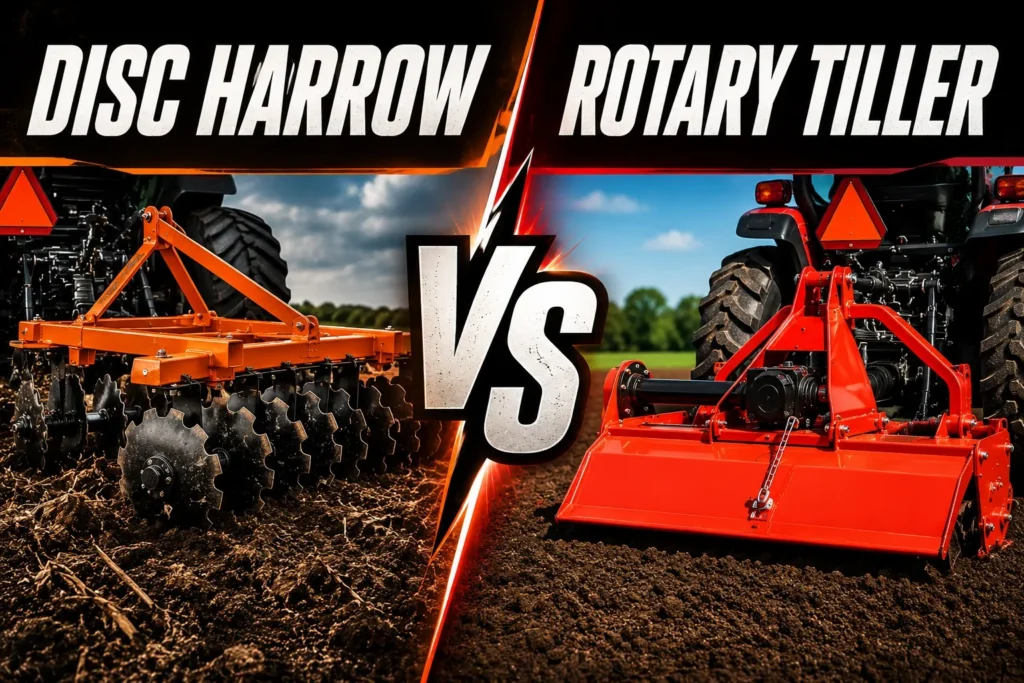
The confusion is understandable. A disc harrow and a rotary tiller both attach to your tractor’s three-point hitch, both prepare soil for planting, and both show up in the same online search results. What most articles don’t explain clearly is that these implements serve different stages of the soil preparation process and that your acreage, soil type, and tractor size should drive the decision more than anything else.
Here’s how to figure out which one belongs on your farm.
What Is a Disc Harrow?
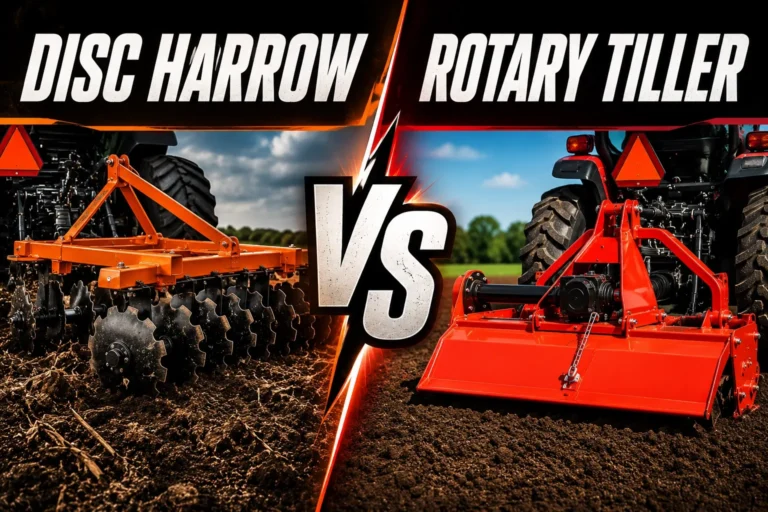
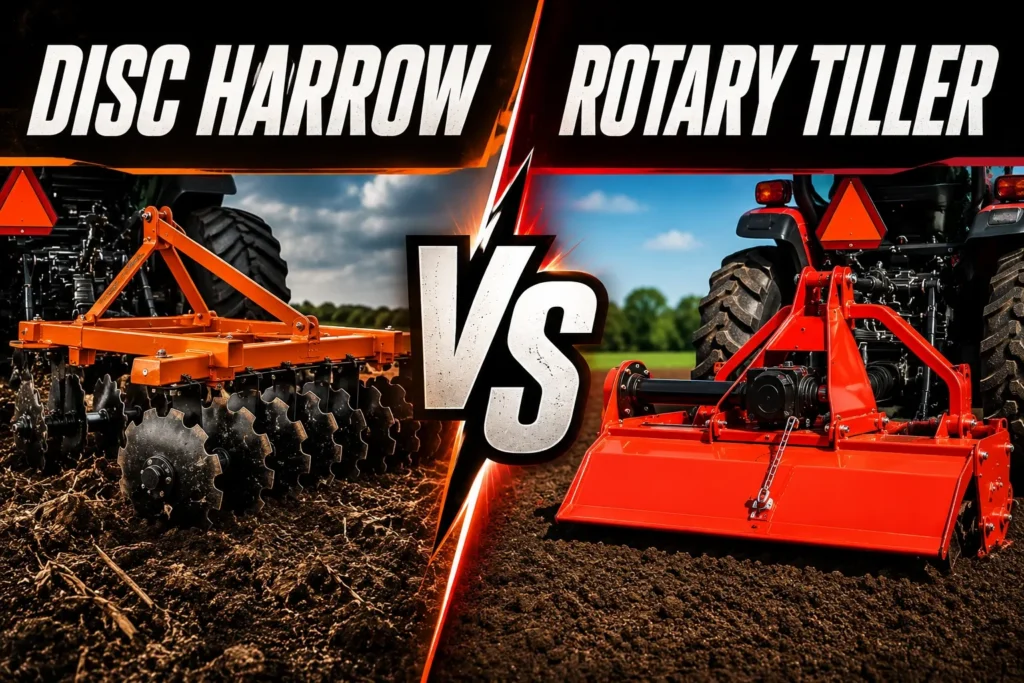
A disc harrow is a primary tillage implement. It uses a series of round steel discs angled and mounted in two or four gangs to cut, break, and invert soil. The discs roll forward while slicing into the ground at an angle, which is what gives the implement its tilling action. There’s no PTO (power take-off, the rotating shaft that connects your tractor to an implement) involved; a disc harrow is purely ground-driven.
What it does well: breaking crop residue, cutting through sod and cover crops, incorporating organic matter, and doing the initial heavy work of opening up a field. On small farms of 5 to 20 acres, a disc harrow can cover ground quickly, typically 3 to 6 mph, but the same advantage scales to larger operations where covering acreage efficiently becomes even more important.
Disc Harrow Advantages
- Covers large areas quickly: 3-5 acres per hour at working speed.
- Handles heavy crop residue, sod, and established cover crops without clogging.
- No PTO required: lower fuel consumption and simpler maintenance.
- Durable and long-lasting: disc blades typically last several seasons before replacement.
- Works well in stony or rocky soils: discs deflect rather than break.
Disc Harrow Limitations
- Doesn’t produce a fine seedbed on its own: usually requires a secondary pass with a tiller or drag
- Minimum effective tractor size is 25–30 hp for a 5-foot disc; larger widths need 40+ hp
- Won’t fully incorporate amendments as thoroughly as a tiller in one pass.
What Is a Rotary Tiller?
A rotary tiller, also called a rototiller or rotavator, is a PTO-driven implement that uses rotating L-shaped or C-shaped tines to chop, blend, and pulverize soil. It’s a secondary tillage tool, though it can handle primary tillage in lighter soils. The tines spin at high RPM, which is what produces the fine, crumbly seedbed that a disc harrow alone can’t deliver.
Most compact tractor rotary tillers run at 540 RPM PTO speed and are sized 4 to 6 feet wide for small farm use. A quality tiller on decent soil can take you from an unworked field to a plant-ready seedbed in a single pass, which is why it’s the go-to tool for market gardeners and small vegetable operations.
Rotary Tiller Advantages
- Produces a fine, uniform seedbed ready for direct seeding or transplanting in one pass
- Thoroughly incorporates compost, fertilizer, and soil amendments
- Best in class for vegetable gardens: Creates the smooth, finely worked seedbed preferred for many vegetable crops with minimal passes.
- Works well on small plots and market gardens, while remaining effective on larger acreages where seedbed quality is a priority.
- Adjustable depth control: typically 2 to 8 inches, depending on model
Rotary Tiller Limitations
- Slower than a disc harrow: 1 to 3 mph working speed limits coverage per hour
- Struggles with heavy sod, dense residue, or wet clay: tines clog and can stall
- PTO load means higher fuel consumption per acre compared to a disc harrow
- Over-tillage risk: repeated deep passes can destroy soil structure and create a hardpan below the tine depth
- More moving parts than a disc harrow: gearbox maintenance and tine replacement are ongoing costs
Disc Harrow vs Rotary Tiller: Quick Comparison
| Factor | Disc Harrow | Rotary Tiller |
| Maintenance | Low replace disc blades every few seasons | Moderate- tines wear faster, gearbox needs oil changes |
| Fuel Consumption | Lower tractor load in most conditions | Higher PTO load is heavier per acre |
| Soil Penetration | 6-10 inches, adjustable disc angle | 4–8 inches standard; deeper models available |
| Seedbed Quality | Good for primary tillage; needs follow-up pass | Good for a ready-to-plant bed in one pass |
| Speed | 3–6 mph covers ground fast | 1–3 mph slower, more thorough incorporation |
| Ease of Use | Simple, few moving parts, easy to adjust | Moderate PTO engagement, depth control required |
| Soil Disturbance | High, significant inversion and mixing | High full incorporation but more uniform |
| Best Farm Size | 3+ acres; most efficient on 5–20 acres | Under 5 acres; 1–3 acres is the sweet spot |
| Tractor Requirement | 25–40+ hp; Category I or II hitch | 18–40 hp, depending on width; 540 RPM PTO required |
How Each Tool Fits Into the Soil Preparation Process
Soil prep isn’t a single pass; it’s a sequence. Understanding where each implement fits in that sequence tells you more than any spec comparison.
1. Breaking New Ground
This is disc harrow territory. If you’re converting sod, a hayfield, or fallow ground into a production field, a disc harrow is how you start. You’re cutting through established root systems and flipping sod work that would clog or stall a rotary tiller immediately. Plan on two to three disc passes at different angles before the ground is ready for anything else.
2. Primary Tillage
Primary tillage means the first working of the soil after harvest or over the winter. Again, the disc harrow earns its place here. It incorporates crop residue, breaks the surface crust, and opens the soil for the next step. A tiller can do primary tillage in light, well-prepared soils, but push it into compacted ground with residue, and you’ll spend more time clearing clogged tines than tilling.
3. Secondary Tillage
After primary tillage, the soil is rough and cloddy. Secondary tillage refines it. This is where the rotary tiller takes over. A single pass at 4 to 6 inches depth breaks clods, incorporates any surface-applied amendments, and leaves you with the smooth, crumbly seedbed that seeds and transplants need.
4. Seedbed Preparation
For direct-seeded crops, carrots, beets, salad greens, seedbed quality is the difference between good germination and spotty stands. The rotary tiller delivers this. The disc harrow alone doesn’t. If uniform germination matters for your crop, the tiller is the final prep tool, full stop.
5. Planting
After a tiller pass, you plant. After a disc pass only, you plant into a rougher bed acceptable for transplants or large-seeded crops like corn or beans, but not ideal for small-seeded vegetables without additional finishing work.
Which Is Better for Different Farm Sizes?
| Farm Size | Best Choice | Why | Minimum Tractor |
| Under 1 acre | Rotary Tiller | Creates a planting-ready seedbed in a few passes; ideal for gardens and intensive vegetable production | 18–22 hp, 540 RPM PTO |
| 1–3 acres | Rotary Tiller (primary); Disc for new ground | Tiller excels at seedbed preparation; disc harrow helps break sod, residue, and previously untilled ground | 22–30 hp |
| 3–10 acres | Disc Harrow and Tiller combo, or Disc alone | Disc covers ground efficiently; tiller remains valuable where a finer seedbed is needed | 30–40 hp |
| 10–20+ acres | Disc Harrow | Greater field capacity and faster coverage; rotary tillers can still be used where seedbed quality is a priority | 40+ hp, Category II |
Under 1 Acre
For most vegetable gardens and small plots, a rotary tiller is usually the more practical choice. You’re not covering enough ground to benefit from a disc harrow’s speed advantage fully, and the tiller’s ability to create a fine, planting-ready seedbed is often more valuable.
1-5 Acres
This is the range where both implements can have a place, but often in sequence rather than direct competition. For established beds, a rotary tiller may be all you need. For new ground, heavy cover crops, or residue management, a disc harrow can handle the initial work before a tiller prepares the final seedbed. If budget forces a choice, many vegetable growers start with a tiller and add a disc harrow later.
5-20 Acres
At 5+ acres, the disc harrow’s speed advantage becomes more noticeable. A 6-foot disc behind a 40 hp tractor can cover acreage much faster than a similarly sized tiller. For many operations in this range, the disc harrow handles primary tillage across the field, while the tiller is reserved for areas that require a finer seedbed.
More Than 20 Acres
For fields of 20 acres or more, the disc harrow often becomes the primary soil-preparation tool. Rotary tillers can still play an important role, particularly on vegetable farms and other operations where seedbed quality is critical, but many larger farms rely on disc harrows and other secondary tillage tools for most field preparation.
Which Is Better for Different Types of Farms?
Vegetable Farms and Market Gardens
Rotary tiller wins here, clearly. The seedbed quality you get from a tiller is what direct-seeded vegetables need (uniform depth, fine tilth, and no large clods). If you’re seeding salad mix, root crops, or small-seeded herbs, there’s no substitute. Many market gardeners on 1 to 3 acres run a tiller exclusively and never own a disc harrow.
Food Plots
Food plot prep is usually once-a-year work on ground that might be converted from native vegetation or fallow. A disc harrow handles the heavy lifting here, cutting through grass, incorporating the existing vegetation, and preparing the surface. For small food plots under an acre, a tiller works too, but don’t push it into thick sod.
Hobby Farms
Hobby farms typically have a mix of uses, such as a small vegetable garden, some pasture, maybe a few beds for flowers or herbs. A rotary tiller is more versatile at the small scale most hobby farms operate on. You can use it for the vegetable garden, till in a cover crop on a small field, and work it around the property without needing the tractor size a larger disc requires.
Which Is Better for Different Soil Types?
Clay Soil
Clay soil is the hardest to work and the most unforgiving of the wrong implement choice. For initial tillage on heavy clay, the disc harrow handles wet and compacted conditions better, and the disc blades cut through where tiller tines want to glide over the surface or clog. Wait until clay soil has dried to the right moisture level before tilling with either implement; working wet clay with a tiller destroys soil structure and creates compacted clumps that take months to break down.
Sandy Soil
Sandy soils are where the rotary tiller shines. Easy to penetrate, minimal clogging risk, and the tiller produces an excellent seedbed quickly. A disc harrow also works fine in sandy soils, but it’s overkill if your only goal is seedbed prep. Use the tiller and move on.
Loamy Soil
Loam is the easiest soil to work with either implement. You have the most flexibility here; both tools perform well. Match your choice to acreage and crop type rather than soil conditions.
Rocky Soil
Disc harrow blades deflect off rocks and keep moving. Rotary tiller tines hit rocks and either break, bend, or transfer an ugly jolt back to the tractor drivetrain. In genuinely rocky soil, repeated tiller use means constant tine replacement. If your field has significant rock content, the disc is the safer tool for primary work.
Soil Health Considerations
Neither implement is neutral when it comes to soil biology. Both disturb soil structure and the microbial communities that live in it. As the USDA notes, maintaining soil health requires protecting the soil’s biological and physical condition over time. How much impact tillage has depends on how often you till, how deep you go, and what you do with the soil afterward. USDA soil health guidance
Soil Structure and Organic Matter
Repeated tillage affects more than just the appearance of the seedbed. Deep or frequent tillage can gradually break down soil aggregates, reducing the crumbly structure that helps with water infiltration and root growth. It also exposes organic matter to air, speeding decomposition. Incorporating compost, cover crops, and residue has benefits, but excessive tillage can offset some of those gains over time. In most situations, the goal is to till only as deeply and as often as necessary.
Compaction and Hardpan
Running a rotary tiller repeatedly to the same depth creates a compaction layer sometimes called tillage hardpan just below the tine depth. This layer restricts root growth and drainage. Vary your tillage depth seasonally, and consider a subsoiler pass every few years if you suspect compaction.
When Less Tillage Is Better
If your soil is already in good condition, loose, well-structured, and biologically active, the best tillage is the minimum needed. No-till and reduced-till systems preserve soil structure and organic matter, but they require either specialized equipment or careful crop rotation management. For most small farms still building soil health, some tillage is practical. The key is not doing more than the crop requires.
Maintenance and Ownership Costs
Disc Harrow Maintenance
Low. The main wear items are the disc blades themselves, which dull and notch over time. On typical small-farm use, a set of disc blades lasts two to five seasons. Individual blades cost $15 to $40 each, and a standard 5-foot tandem disc might have 12 to 16 discs total. Bearing replacement and scrapers (which keep soil from building up on the discs) are the other periodic costs.
Annual maintenance checklist: inspect disc blades for notching and dullness, grease all bearings every 8 hours of use, check scraper clearance, and inspect gang bolts for tightness.
Rotary Tiller Maintenance
More involved. Tines are the main wear item, and they take a beating in rocky or heavy soils. Budget $8 to $20 per tine, and a 5-foot tiller has 36 to 48 tines. More importantly, the gearbox requires regular oil changes (check your manual, most recommend every 50 hours) and is the most expensive repair item if neglected.
Annual maintenance checklist: inspect and replace worn tines, change gearbox oil per manufacturer’s schedule, check chain tension on chain-drive models, grease all fittings, inspect PTO shaft and slip clutch.
Long-Term Ownership
A quality disc harrow bought used in good condition will outlast most tractors it’s paired with. The BCS and King Kutter disc harrows regularly run for 20+ years with basic maintenance. A rotary tiller’s lifespan is more dependent on how it’s used, abusing it in heavy soils or running it with neglected gearbox oil cuts that lifespan significantly. Buy a name-brand tiller (Land Pride, Befco, Woods) over the no-name imports if you plan to run it hard.
Buy a Disc Harrow If…
- Your farm is 5+ acres, and soil prep speed is a real constraint
- You’re breaking new ground, converting sod, or dealing with heavy crop residue
- Your soil is rocky discs that deflect off rocks; tiller tines don’t
- You’re managing pasture, hay ground, or cover crop incorporation across a larger field
- You plan to do primary tillage across the whole farm and only use a tiller on select high-value beds
Buy a Rotary Tiller If…
- You’re growing vegetables and need the fine seedbed quality that direct seeding requires – see our guide on cultivator vs tiller decisions for small farms for how tillers fit into overall cultivation strategy
- Your farm is 1–5 acres, and seedbed quality matters more than prep speed
- Your soil is already worked, and you need to incorporate amendments or refine the surface
- You’re planting small-seeded crops, carrots, lettuce, radishes that need a uniform, fine tilth
When It Makes Sense to Own Both
If your farm is 3 to 15 acres and you’re growing a mix of row crops and vegetables, owning both implements is the most efficient setup, not overkill. The typical workflow looks like this: disc harrow in fall to incorporate residue and prepare the field through winter, rotary tiller in spring to finish beds before planting. Each implement does 60% of its work in a single season pass.
This two-pass system also protects your tiller. Discing first removes the heavy residue and breaks initial compaction, the jobs that wear tiller tines and stress gearboxes fastest. Coming in with the tiller on already-worked ground means lighter loads and longer tine life.
The purchase sequence that makes the most sense for most small farms: buy the tiller first (better for small operations, vegetable production, and immediate seedbed needs), then add the disc harrow when you’re managing enough acreage that prep time is genuinely limiting your operation.
Frequently Asked Questions
Is a disc harrow better than a tiller?
No. A disc harrow is better for breaking ground, managing residue, and covering acreage quickly. A rotary tiller is better for creating a fine seedbed for vegetables and direct seeding.
Can a disc harrow replace a rotary tiller?
Sometimes, but not always. A disc harrow can prepare soil for many crops, but it typically won’t create the fine seedbed needed for small-seeded vegetables such as carrots, lettuce, and radishes.
Which implement is better for vegetable gardens?
For most vegetable gardens, a rotary tiller is the better choice. It creates the fine, uniform seedbed that vegetable crops and direct seeding require.
What size tractor do I need for a disc harrow?
Most 5-foot disc harrows require 25-35 hp, while 6-foot models often need 35-45 hp or more. Heavy soils and deeper tillage increase horsepower requirements.
What size tractor do I need for a rotary tiller?
A 4-foot tiller typically works with 18–25 hp tractors, while 5 and 6-foot models commonly require 25–50 hp. Always verify the manufacturer’s PTO horsepower recommendation before buying.
Can I prepare soil without owning both?
Yes. Many small farms use only a rotary tiller, while larger operations often rely on a disc harrow and a finishing tool. Owning both provides the most flexibility, but it isn’t necessary to get started.
Final Thought
Here’s the honest summary: most small farmers need a rotary tiller first and a disc harrow later, if at all.
If you’re farming 1 to 5 acres with a compact tractor and growing vegetables, the rotary tiller is the right single implement. It handles seedbed prep better than any alternative at that scale, and the limitations around heavy sod and primary tillage rarely come up if you’re working established ground.
If you’re farming 5 to 20 acres, especially with a mix of crop types, the disc harrow is the primary tillage workhorse, and the tiller is the finishing tool for high-value beds. At this scale, the disc pays for itself in time savings within the first season.
And if you’re breaking new ground, converting pasture, opening woodland edges, or dealing with established sod, the disc harrow isn’t optional. No amount of tiller passes substitutes for what a disc does on rough, virgin ground.