

Sometimes you go out to clear a section of your land, thinking it’s just weeds, and then you step into it. What looked like tall grass from a distance turns into thick stems, tangled vines, and even small trees pushing through. Now your mower struggles, your trimmer feels useless, and you start wondering if you bought the wrong tool.
That’s where most small farmers get it wrong.
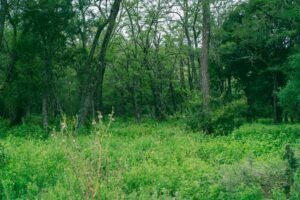
The problem isn’t the tool; it’s misreading the land.
What you’re dealing with could be light weeds, thick overgrowth, dense brush, or even young trees. And each one requires a completely different approach. Use the wrong equipment, and you’ll waste time, damage your machine, or end up doing the job twice.
This guide is built to fix that.
Instead of throwing a list of tools at you, we’re going to help you identify exactly what’s growing on your land, and match it to the right tool the first time. And when that growth gets too thick for a trimmer or regular mower, choosing the best walk-behind brush mower for small farmers becomes part of doing the job right from the start.
Quick Decision: What Does Your Land Look Like Right Now?
| If your land looks like this… | Land type | Tool to reach for |
|---|---|---|
| Tall grass, soft weeds, easy to walk | Light Weeds | String trimmer |
| Chest-high growth slows your walking | Moderate Weeds | Self-propelled brush mower or small tractor |
| Woody stems, vines, hard to push through | Dense Brush | High-torque brush mower (chainsaw for thicker sections) |
| Small trees with thin trunks are taking over | Saplings | Chainsaw first, then brush mower |
| A mix of all of the above | Mixed Regrowth | Chainsaw, then brush mower |
Match Your Land Type: The Core Guide
Light Weeds
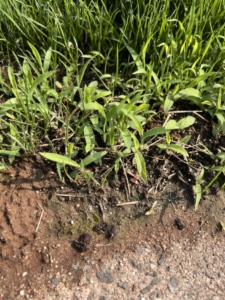
Tall grass, ragweed, pigweed, or other soft-stemmed weeds. You can walk through it without fighting it. Stems are flexible, not woody. Growth is probably knee- to waist-high.
Best tools to use:
String trimmer (brush blade attachment): Works well on patches up to about a quarter acre. Swap the line head for a blade if stems are over an inch thick.
Walk-behind brush mower: Faster and less tiring than a trimmer on anything over a quarter acre. A DR Field & Brush Mower or similar handles this with no drama.
Tractor with finish mower: If you have a tractor, a finish mower handles light weeds efficiently. Don’t overthink it.
What to avoid:
Renting a skid steer or track machine for soft weeds. That’s bringing a sledgehammer to a task that needs a hammer.
Buying a commercial-grade brush mower for land that’s actually this manageable. You’ll overspend by $800.
Most people overestimate the power they need for light weeds. A solid string trimmer with a blade attachment clears a lot more than people expect, and it’s maneuverable in tight spots around fencing and trees that any mower will struggle with.
Moderate / Thick Weeds
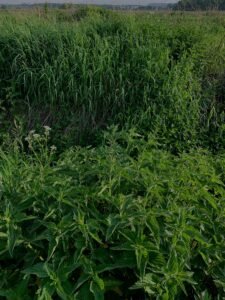
Chest-high goldenrod, thistle, or dense grass that slows your walking. Stems are still mostly soft, but there’s volume and density. You can push through, but you feel the resistance.
Best tools to use:
Self-propelled walk-behind brush mower: This is the sweet spot for this land type. The self-propelled drive means you’re steering, not wrestling it forward. The DR Field & Brush Mower handles this category well on 1–5 acres.
Flail mower (tractor attachment): If you have a tractor with a 540 RPM PTO (power take-off, the rotating shaft that drives implements), a flail attachment like the MechMaxx 60” covers ground fast and mulches as it goes.
What to avoid:
String trimmers for anything over half an acre of this density. You’ll burn through string, wear out your arms, and cover 10% of the ground in the same time.
Finish mowers. The decks aren’t built for height, and thick weeds can clog or stall them.
This is the land type where people make the most expensive mistakes. They buy an underpowered push mower, get frustrated after 45 minutes, and come back for something bigger. We can say a self-propelled brush mower is worth every dollar on this terrain.
Dense Brush
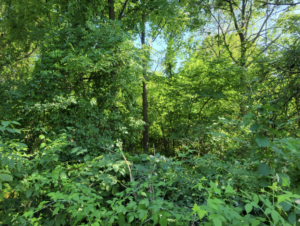
Stems are stiff and snap instead of bending. You can’t walk through without picking a path. Vines may be tangled through the growth. Cutting once usually just delays them; you’ll want a management plan that includes repeated clearing or herbicide follow-up. This is a real brush, and it needs real power.
Best tools to use:
Chainsaw: On the thickest stands, clear the main woody mass with a chainsaw first, then follow with a brush mower.
High-torque walk-behind brush mower: The Billy Goat BC2600HH with its 265cc Honda GX engine is the walk-behind built for this. High blade tip speed cuts woody stems cleanly instead of bending them over.
BCS flail mower: If mulching in place matters for your operation, orchard floors, market garden edges, the BCS flail shreds dense growth and returns it as organic material. Slower than a rotary, but better for the soil.
What to avoid:
Underpowered machines in this category. A 190cc engine that bogs in thick multiflora rose means belt slip, overheating, and multiple passes where one should have done it. You pay for low power in time and repair bills.
String trimmers entirely. A brush blade on a trimmer can nick stems, but you won’t clear an established brush thicket with one. It’s not built for it.
Multiflora rose is the most common “mistake category” for buyers. It looks manageable from 20 feet away. Get in there, and it’s brutal on equipment. If you’ve got serious multiflora rose on more than a third of your clearing area, budget for the Billy Goat.
Saplings (Young Trees Taking Over)
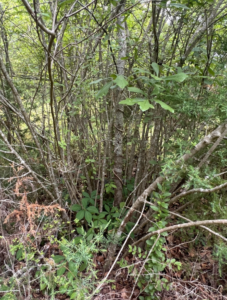
They’re not trees yet. They are tree seedlings that got two or three growing seasons of a head start. Once they hit 1.5 inches in diameter, most walk-behind brush mowers are at their limit. Although some walk- behind brush mowers are built to crush up to 2-inch saplings( DR Field & Brush Mower and Billy Goat BC2600HH ).
Best tools to use:
Chainsaw (for trunks over 1 inch): Cut the larger ones down first. This isn’t optional.
Walk-behind brush mower (for trunks under 1-2 inch): The DR Field & Brush Mower and Billy Goat BC2600HH both cut saplings under 1 or 2 inch confidently. Use a brush blade, not a flail hammer, for woody stems.
String trimmer with blade (for 1/4-inch or smaller): New-growth saplings still in their first season can often be knocked down this way before they establish.
What to avoid:
Mowing over saplings without cutting them first. The stump that springs back is harder than the original growth, and it’ll keep coming.
BCS flail mowers for sapling clearing. Flail hammers bend on woody stems over 3/4 inch. It’s not what they’re built for.
Most people hit 1.5-inch saplings with a brush mower and expect it to handle them. It won’t, and the damage shows up in bent blades and stalled engines, not during the cut but right after. Use a chainsaw for anything you can’t snap with your hands. That’s the honest cutoff.
Mixed Regrowth
This is the hardest category to buy for, and it’s where most mistakes happen. This is either an abandoned land that has gone through multiple stages of succession without any management. The weeds came first, the brush moved in behind them, and the trees came last. You’re not dealing with one problem; you’re dealing with three layered on top of each other.
Best approach (in order): Don’t try to do this in one pass with one machine.
Chainsaw first: Walk the whole area and cut every sapling and woody stem over 1 inch. Stack or scatter to dry.
High-torque brush mower second: After saplings are cleared, the brush mower handles the remaining growth without fighting trunks. Billy Goat BC2600HH or similar for anything with real density.
Follow-up pass: Return in 6–8 weeks. New growth from cut stumps will have sprouted. A second pass prevents re-establishment.
What to avoid:
Buying one machine and expecting it to do everything. There isn’t one.
Starting with a flail mower in mixed regrowth. Flail hammers bend on woody stems. Save the flail for cleanup passes after major clearing.
Clearing in one direction only. Work in sections, not sweeping rows, so you don’t push debris into areas you’ve already cleared.
Mixed regrowth is where most people underestimate the project. It looks like a one-pass job from the outside. Once you’re in it, you realize it’s a three-step process with different equipment at each stage. Plan for that upfront, and the whole project goes faster and cheaper than if you try to power through with a single machine.
Common Mistakes That Cost Small Farmers Money
These aren’t edge cases; they’re the most common calls service centers get in May and June from people who bought something in March.
• Using a string trimmer for thick brush. A trimmer with a blade attachment is useful for light work and tight spots. Push it into woody brush, and you’ll burn through blades and strip gearboxes faster than you’d believe. It’s the wrong tool.
• Trying to mow saplings. No walk-behind brush mower reliably handles trunks over 1 inch in diameter, regardless of what the spec sheet says. The spec sheet measures blade torque, not what happens when you hit an angled trunk in wet conditions. Use a chainsaw first.
• Buying underpowered equipment for the job. A 190cc engine is fine for tall weeds. It’s not fine for established multiflora rose. You’ll feel the difference in the first 20 minutes, and you’ll pay for it in a second equipment purchase.
• One-and-done thinking. Cut the brush once, and it grows back. Cut it twice in the same season, and you start to win. Managing overgrown land is a multi-season project, not a single clearing event. Budget your equipment choice accordingly.
• Ignoring slope. Any walk-behind brush mower over 200 lbs gets significantly harder to manage on slopes over 15 degrees. If you have steep terrain, that has to be part of your equipment decision, not an afterthought.
What Each Tool Is Actually Good For
| Tool | What it’s actually good for |
|---|---|
| String trimmer (brush blade) | Light weeds, tight spots, first-season saplings under 1/4 inch. Not for brush. |
| Walk-behind brush mower (self-propelled) | Moderate weeds, dense brush, saplings under 1 inch. The main tool for clearing overgrown small farms (1–5 acres). |
| Chainsaw | Saplings over 1 inch, clearing mixed regrowth before mowing, and downed trees. Not a mowing tool. |
| Flail mower (walk-behind or PTO) | Best for maintenance, not initial clearing. Handles grass and light regrowth well. Not for woody brush or saplings. |
| PTO tractor attachment (rotary/flail) | Wide-area maintenance on 3–10+ acres. Requires a tractor (25+ HP, 540 RPM PTO). |
Once you’ve knocked everything down and brought the land under control, the next step is preparing the ground, and choosing the right soil-preparation equipment for small farms can make a big difference.
Frequently Asked Questions
Can a brush mower cut saplings?
Yes, but only up to a point. Most walk-behind brush mowers handle saplings up to about 1–2 inches. Anything thicker should be cut first with a chainsaw.
What size engine do I need for a brush mower?
It depends on your land. Under 200cc works for light weeds, while 250cc and above is better for dense brush and tougher conditions.
What’s the difference between a brush mower and a flail mower?
A brush mower is for rough clearing, while a flail mower is better for maintenance and mulching after the land is already under control.
Can I use a string trimmer for thick weeds or brush?
Not really. A string trimmer works for light weeds, but it becomes slow and inefficient once the growth gets thick or woody.
What’s the biggest mistake people make when clearing overgrown land?
Using the wrong tool. Most people underestimate how thick their land is and end up buying equipment that’s too small.
Do I need a tractor to clear overgrown land?
Not always. For 1–5 acres, a walk-behind brush mower is usually enough. A tractor helps when covering larger areas.
How often should I clear the land after the first cut?
At least once more in the same season. One pass knocks it down, but a second pass helps control regrowth.
Final Thought
Most of the time, the wrong equipment purchase comes from looking at the tool before looking at the land. Someone sees a great deal in a brush mower and works backward to justify it. That’s how you end up with a 265cc machine you don’t need, or worse, a 190cc machine that’s not enough. The sequence that works: walk your land, identify the worst section, pick that land type from this guide, then choose the tool that matches it. Your worst section sets the minimum spec. Everything else is budget.