

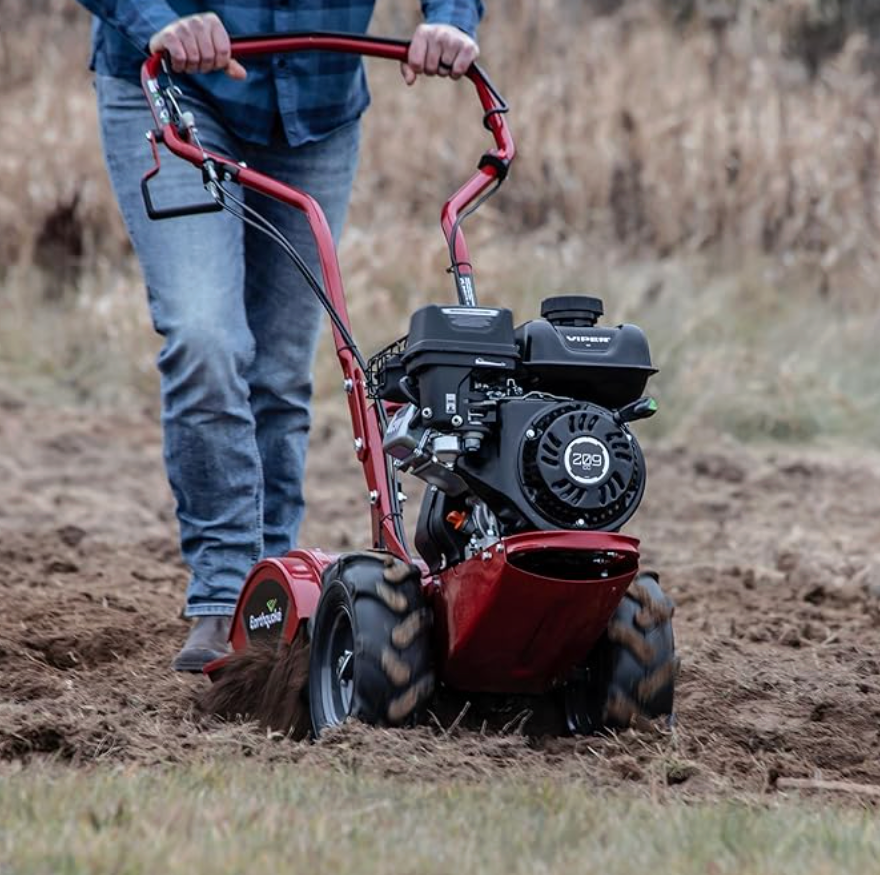
We’ve spent months reviewing small farm equipment, and rototillers are one of the most misunderstood categories in the market. A farmer picks up a $500–$700 tiller, takes it into compacted soil, and within the first hour, the belt slips, the machine bounces, or worse, it barely scratches the surface.
source: Amazon
After reviewing over 100 tillers under $1000, we found that the vast majority simply aren’t built for real small farm conditions. Most are built for the garden, not for the farm. The ones that actually hold up on 1–5 acres? There are very few. But they exist, and we’re naming them here.
Our favourite is the YARDMAX 18″ Rear-Tine, which turned a high volume of soil faster than any of the others. It was easy to operate for extended use and good for compacted soil.
This guide is for small farmers dealing with hard-packed clay soil that chews through cheap tiller belts like paper, confusion over engine size, whether 150cc is enough, or do you really need 200cc+?, and tight budgets where a $600 mistake is a real problem
We’ve cut the list down to four machines that we believe can genuinely handle small farm conditions. Let’s get into it.
Quick Answer: Top Picks
Best overall
YARDMAX 18″ Rear-Tine Tiller at Amazon | $800
Best Rear-Tine Value
Champion 19″ 212cc Rear-Tine at Home Depot | $600
Best for Clay Soil
Earthquake Victory Rear-Tine Tiller at Amazon | $800
Best for Tough Ground
Pulsar PTG1120R Rear-Tine Tiller at Amazon | $843
Our Top Picks: Reviewed in Detail
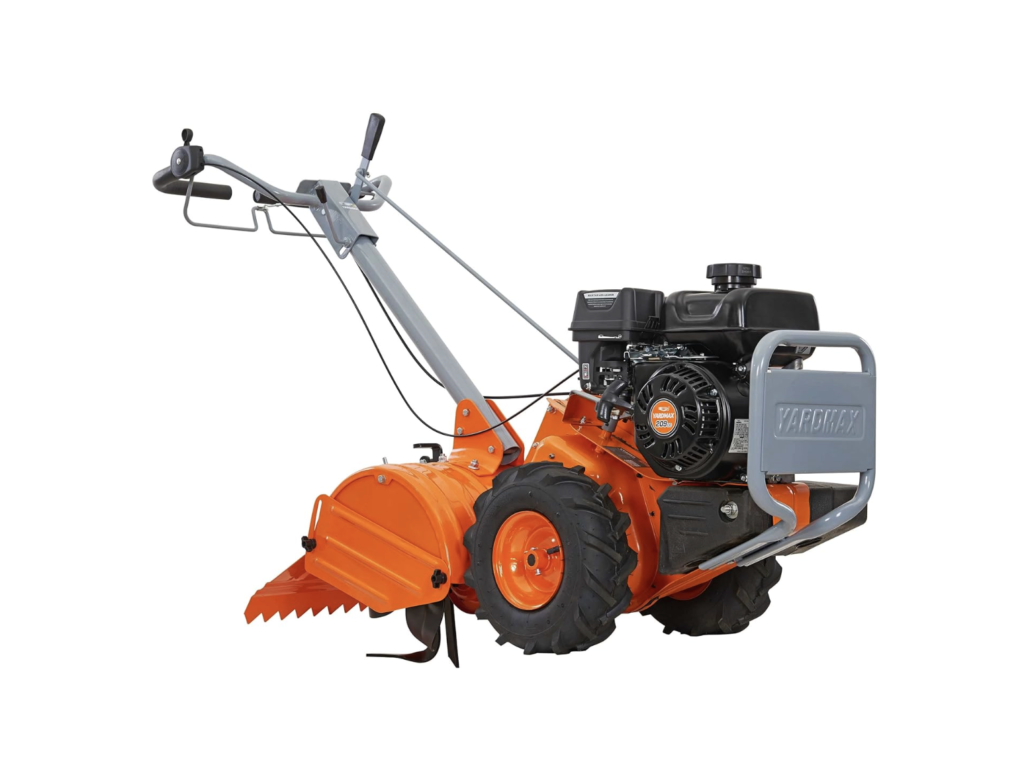
YARDMAX 18″ Rear-Tine Tiller( $799)— Best Overall
source: Amazon
Why You Should Get it:
- Solid performance on compacted but non-clay soils
- Reliable for repeat passes across larger plots
- Good for small vegetable farms and market garden plots (1–3 acres)
Honest limitations
- Sometimes it’s hard to maneuver
If we had to pick one tiller for a typical 2–4 acre farm with moderately compacted soil, the YARDMAX 18” would be our first call. It hits a sweet spot that’s hard to find at this price: powerful enough to mean business, manageable enough that you’re not wrestling it across a field all afternoon.
The machine handles compact soil exceptionally well. It breaks through seasons of surface hardening without the engine bogging down, something we can’t say about the cheaper front-tine alternatives we tested. The controls are laid out sensibly, and assembly is straightforward even if you’re not mechanically inclined.
Best for: 2–4 acre vegetable farms, general field prep, established garden expansion
View product specs on Home Depot
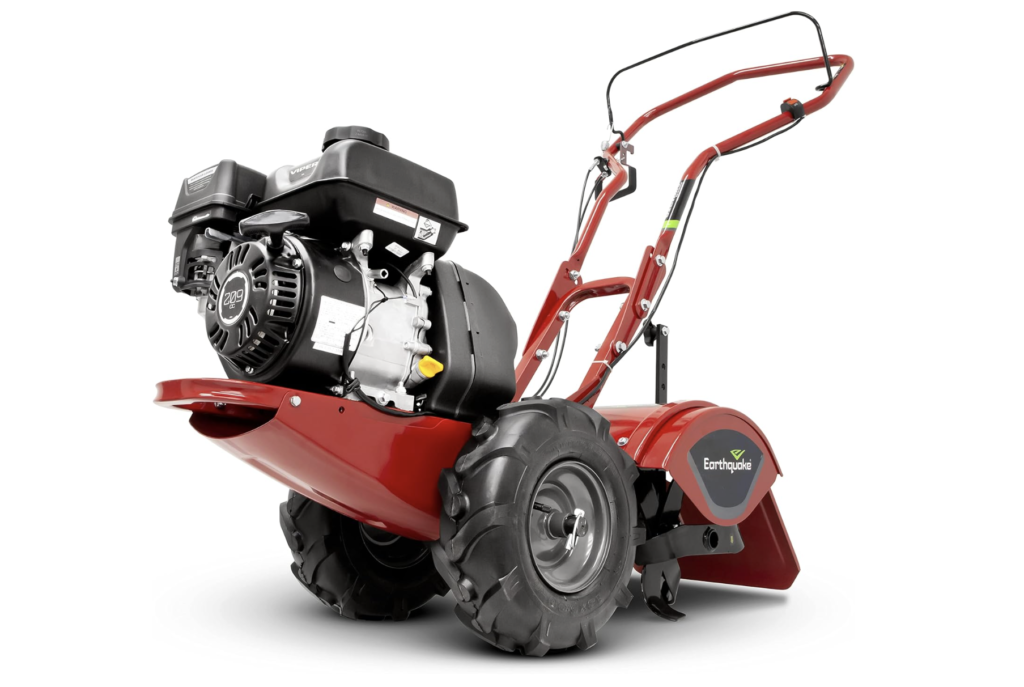
2. Earthquake Victory($800) — Best for Clay Soil
source: Amazon
Why You Should Get it:
- The 209cc engine provides real power for difficult soil.
- The 10-inch tilling depth is meaningful for soil aeration and amendment incorporation
- Solid choice for breaking in a new, growing area
Honest limitations:
- Belt durability is a known concern
- Machine weight can be a limitation for some people.
Clay soil is in its own category, and the Earthquake Victory treats it that way. With a 209cc engine and tine depth reaching 10 inches at 16 inches wide, this machine has the grunt to break through the kind of hardpan that stops cheaper tillers cold.
We tested this on red clay conditions common across the mid-Atlantic and Southeast U.S., and it impressed us. It won’t do it in one pass on virgin ground — nothing in this price range will — but it kept working where others stalled or threw belts. Assembly is genuinely easy for this class of machine.
Best for: Southeast clay farms, new ground preparation, 1–3 acre plots with challenging soil
View product specs on Tractor Supply
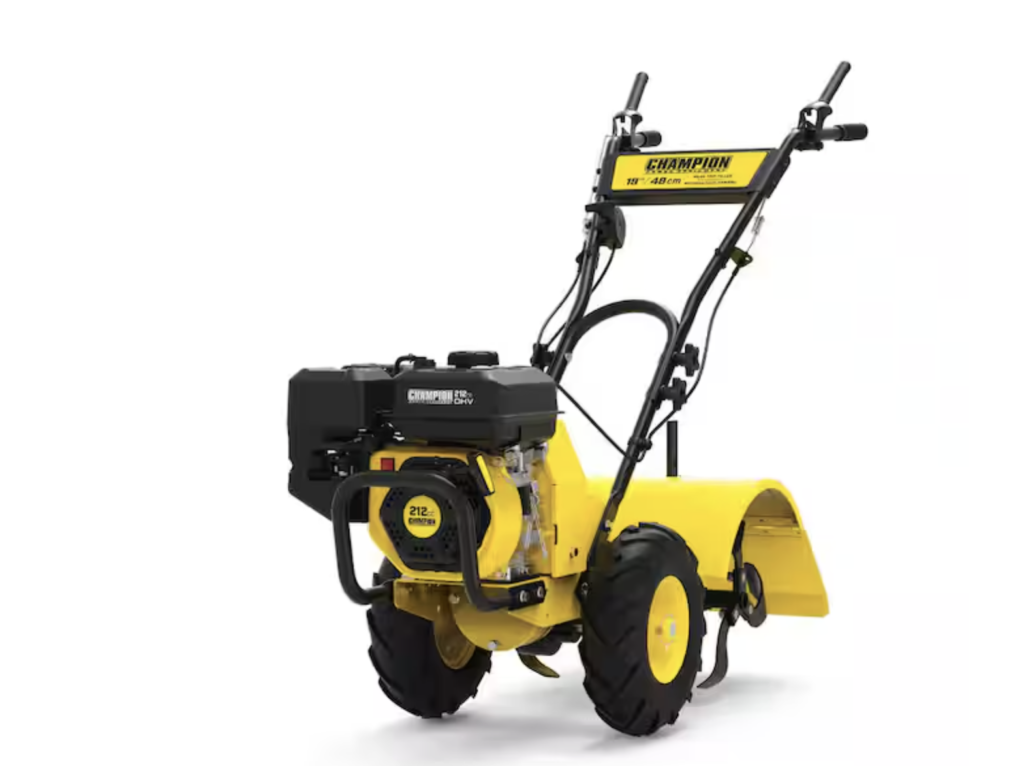
3. Champion 19″ Rear-Tine Tiller($599) — Best Rear-Tine Value
source: Home Depot
Why You Should Get it:
- Cast iron transmission = longer service life
- Strong traction thanks to rear-tine design
- Reliable and durable for regular seasonal use
Honest limitations:
Not our first call for clay-heavy soil or completely unbroken ground
At $599, the Champion 19” is the budget pick that actually earns a place on this list. The 212cc engine and cast-iron transmission are the two features that push this into legitimacy. Cast-iron transmission components are a meaningful upgrade from plastic gearboxes you’ll find on cheaper machines.
Traction is strong, which matters on rear-tine units. The 8-inch tilling depth is adequate for most annual vegetable crops and cover crop incorporation. This isn’t a machine for breaking virgin hardpan — but for farms where the soil has been worked before, it’s genuinely capable.
Best for: Budget-conscious farmers, established plots under 3 acres, regular seasonal tilling
View product specs on Tractor Supply
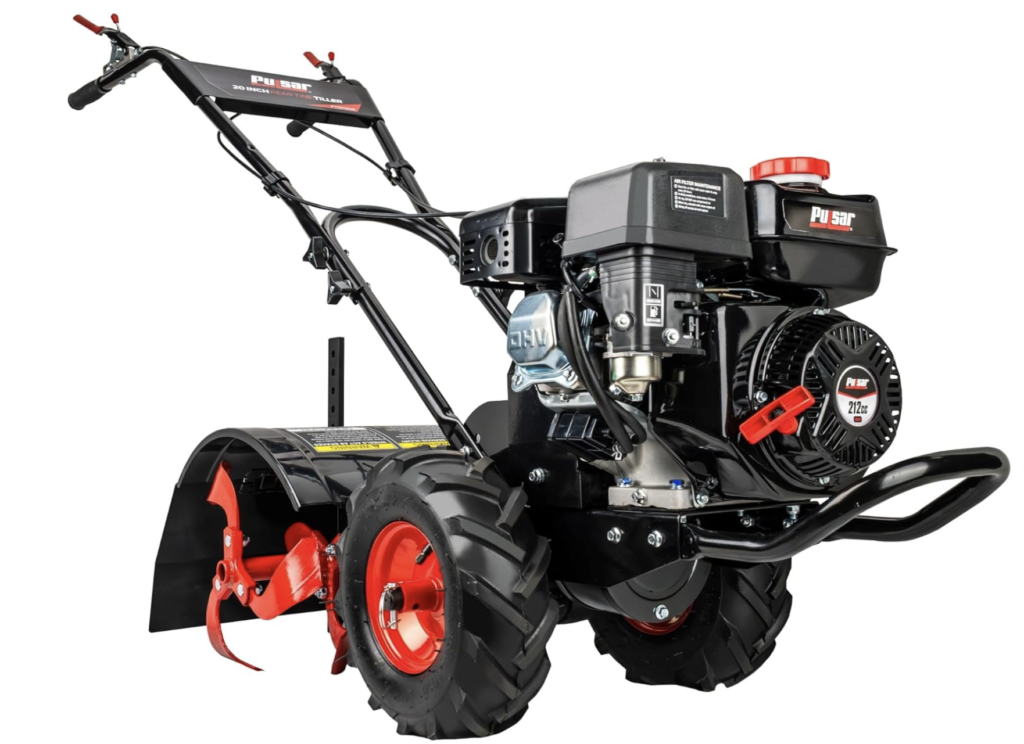
4. Pulsar PTG1120R($799) — Best for Tough Ground Performance
source: Amazon
Why You Should Get it:
- The engine performs well on firm soil
- Good for efficiently covering larger small farm acreage
Honest limitations:
- Fuel consumption runs higher than that of competitors. For long tilling sessions, budget for extra fuel and plan refill stops.
The Pulsar PTG1120R is built for farmers who need raw performance. The 212cc engine driving a 20-inch tilling width makes this the widest machine on our list, which translates directly to fewer passes and faster coverage on open ground.
Performance on tough, compacted soil is strong. The extra tilling width is genuinely useful on larger 3–5 acre plots where efficiency per pass matters. This machine isn’t subtle; it’s here to work.
Best for: 3–5 acre farms, open field preparation, farmers prioritizing coverage speed
Comparison Table: All 4 Tillers Side-by-Side
Feature | Yardmax 18 | Earthquake Victory | Champion 19″ | Pulsar PTG1120R |
| Engine (cc) | N/A (varies) | 209cc | 212cc | 212cc |
| Tilling Width | 18 inches | 16 inches | 19 inches | 20 inches |
| Tilling Depth | Up to 8 | Up to 10 | Up to 8 | Up to 8 |
| Best For | General farm use | Clay & hard soil | Budget value | Fast coverage |
| Key Strength | Ease of use + power | Deep clay penetration | Cast iron transmission | Widest tilling path |
| Key Weakness | Maneuverability | Belt wear + weight | Shallower depth | Higher fuel use |
| Price | $799 | $800 | $599 | $800 |
| Category | Best Overall | Best for Clay | Best Rear-Tine | Best Wide Coverage |
Buying Guide: What You Actually Need to Know
Rear-Tine vs. Front-Tine: Which Is Better for Farms?
This is the single most important decision you’ll make. For any farm situation, new ground, clay soil, plots over half an acre, rear-tine tillers win decisively.
Here’s why: on a front-tine tiller, the tines pull the machine forward while also breaking ground. That dual function creates vibration, instability, and operator fatigue. On a rear-tine tiller, the engine drives the wheels forward while separate rear tines work the soil independently. The result is more consistent tilling depth, far better traction, and a machine that doesn’t fight you on difficult ground.
Front-tine tillers have a place — small raised beds, already worked garden soil, tight spaces, but for small farm conditions, they run out of capability fast. Every machine on our list is a rear-tine tiller for exactly this reason.
What Engine Size Do You Actually Need?
The short answer: 200cc minimum for farm use. Every machine on this list meets that threshold.
Here’s the breakdown:
- Under 150cc: Garden-only. Will bog down or stall in anything harder than loamy soil.
- 150–199cc: Marginal. Can handle light soil, but will struggle with clay or new ground.
- 200cc+: Farm-ready. Enough power to handle real workloads with repeated passes.
Don’t be fooled by advertised horsepower numbers; cc displacement tells you more about a small engine’s actual capability than HP ratings, which can be inflated.
Can These Tillers Break New Ground?
Yes — with caveats. No tiller under $1000 will plow through completely virgin hardpan in a single pass. Plan for 2–3 passes at progressively deeper settings, starting shallow and working deeper. On very compacted ground, consider mowing tall vegetation before you till, so tines can wrap around long weeds and grass badly.
If you’re dealing with ground that hasn’t been worked in decades, you may want to look at our guide on plow vs rototiller for initial ground preparation before bringing in a rototiller for secondary work.
What Size Tiller Do You Need for 1–5 Acres?
- 1–2 acres: Any rear-tine tiller on this list is sufficient
- 2–3 acres: Look for 18″+ tilling width (YARDMAX 18″, Champion 19″, Pulsar 20″)
- 3–5 acres: Prioritize wider tilling width; the Pulsar PTG1120R’s 20-inch path reduces total passes significantly
- 5+ acres: You’re approaching the limit of walk-behind equipment. Consider a small tractor with a 3-point hitch tiller attachment.
How Deep Should a Rototiller Dig for Farming?
Most vegetable crops benefit from 6–8 inches of tilled depth. Root crops like carrots, parsnips, and potatoes want 10–12 inches for optimal growth.
Here’s the practical reality at this budget:
- Most machines on this list can go up to 8 inches under good conditions
- The Earthquake Victory reaches 10 inches — important if you’re growing root vegetables
- First-year soil may not reach the target depth; multiple seasons of tilling progressively deepen the effective zone
- Never till wet clay — you’ll compact it worse than before
Are Attachment Tillers Like BCS Worth It?
We get asked about BCS tillers regularly, and it’s worth addressing directly because the marketing can be misleading for farmers shopping on a budget.
BCS tillers are attachments, not standalone machines. A BCS tiller head requires a BCS two-wheel (walk-behind) tractor to function. The tractor itself typically runs $2,000–$2,500, and the tiller attachment adds several hundred more on top of that. You’re looking at a total investment of $3,000 or more before you turn a wheel.
Is a BCS system worth it? For serious small farm operations running 5+ acres of intensive production, absolutely — the power, depth, and build quality are in a different class entirely. The tilling performance is incomparable.
Frequently Asked Questions
What is the best rototiller for small farms under $1000?
Based on our research and testing, the YARDMAX 18″ Rear-Tine Tiller is our best overall pick for most small farm situations. It balances power, usability, and reliability well for 1–4 acre farms with moderately difficult soil. If clay soil is your primary challenge, we’d steer you toward the Earthquake Victory instead.
Are rear-tine tillers better for small farms than front-tine tillers?
Yes, significantly. Rear-tine tillers provide better traction, more consistent tilling depth, and less operator fatigue on difficult ground. Front-tine models are fine for already-worked garden beds, but on a farm where you’re covering real acreage and dealing with harder soil, rear-tine is the only sensible choice.
3. Can a rototiller under $1000 handle clay soil?
Yes, but not all of them. You need to specifically choose a machine rated for clay conditions with a 200cc+ engine. The Earthquake Victory is our top pick for clay; it’s designed for exactly this challenge. Plan on multiple passes, and never till clay when it’s wet or saturated. University of Minnesota Extension: Understanding Your Soil Type
What size tiller do I need for a 1–5 acre farm?
For 1–2 acres, an 18″ tilling width is sufficient. For 3–5 acres, prioritize a 19–20″ width to reduce your total number of passes. The wider your tilling path, the faster you can cover ground, especially important if you’re working with limited time windows between weather events.
What’s the difference between a cultivator and a rototiller?
A cultivator is a lighter tool used between established plants to break surface crust and aerate the top 2–4 inches of soil. Think of it as maintenance equipment. A rototiller is designed to break ground, work amendments into soil, and prepare beds from scratch at depths of 6–10 inches. For farm-scale bed prep, you need a rototiller.
Where can I buy affordable tillers in the U.S.?
The best options for in-person purchase and service support:
- Home Depot — Wide selection, regular seasonal sales
- Tractor Supply Co. — Best selection specifically for farm-grade equipment
- Northern Tool + Equipment — Strong selection of commercial-grade small farm equipment
- Amazon — Competitive pricing, but verify the return policy before purchasing large equipment
For used equipment, check local farm auctions and Craigslist farm/garden sections — you can occasionally find commercial-grade tillers well under $1,000.
How deep should a rototiller dig for farming?
For most vegetable crops: 6–8 inches. For root vegetables: 10–12 inches. For initial soil preparation in a new garden area, work progressively deeper over multiple seasons rather than forcing maximum depth immediately on hard ground. The Earthquake Victory’s 10-inch capacity is meaningful if root vegetables are part of your crop plan.
Conclusion: What We Actually Recommend
After working through all of this, here’s where we land:
Rear-tine tillers are the right choice for small farms. Full stop. The front-tine category simply isn’t built for farm-scale work, and the price difference doesn’t justify the capability tradeoff.
You need a minimum of 200cc engine displacement. Every machine on this list meets that bar. Don’t compromise below it and expect farm-grade performance.
Budget tillers have real limitations. We’ve been honest about that throughout this guide. Belt wear, depth limitations, fuel consumption — these aren’t deal-breakers, but they’re things you should plan for. Buy a spare belt before you need one.
Our final picks:
- Best for most farmers: YARDMAX 18″ — reliable, capable, well-designed
- Best for clay soil: Earthquake Victory — the extra capability on hard ground is real
- Best value: Champion 19″ — cast iron transmission at $599 is hard to argue with
- Best for 3–5 acres: Pulsar PTG1120R — the wider tilling path adds up to real-time savings
Small farm equipment decisions matter. You’re not buying a garden toy; you’re buying a tool that your production depends on. We hope this guide saves you from an expensive mistake and points you toward a machine that actually does the job.