

Most small farmers get turned down for equipment financing, not because they can’t afford it, but because they walked into the wrong lender with the wrong paperwork. That’s a fixable problem.
If you’re running a 2 to 50-acre farm, you already know this isn’t a small decision.
A single financing mistake can lock you into years of high payments, limit your ability to grow, and quietly eat into your profits season after season.
This guide cuts through the lender noise and gives you the exact path from ‘I need a tractor’ to ‘I’m approved.’ Whether your credit is spotless or you’ve been turned down before, there’s a realistic option here for your operation. We’ll show you the rates, the monthly payments, and the one number that protects you from taking on more than your farm can carry.
Farm Equipment Loan Rates (2026)
If you’re here for numbers first, here’s the reality:
-
USDA loans: 4.5% – 5.8%
-
Farm Credit equipment loans: 5% – 8%
-
Dealer financing: 0% – 9%
-
Banks: 6% – 10%
For most small farmers, USDA and Farm Credit offer the lowest interest rates and best approval chances.
Now, let’s break down how to use these options the right way
Assessing Your Needs – The Pre-Financing Audit
Financial Soil Test
Before you walk into a bank or a dealership, you need to conduct a “Financial Soil Test.” Just as you wouldn’t put too much fertilizer on a field, you shouldn’t take out too much debt for machinery that is bigger than what your acreage needs:
Step 1: Calculate Your Farm’s Net Operating Income (NOI)
NOI = Total farm revenue minus all operating costs (seeds, labor, fertilizer, fuel, land lease). Do not subtract loan payments, yet they come next.
Example: A 5-acre vegetable farm grosses $52,000. Operating costs are $31,000. NOI = $21,000.
Step 2: Apply the 15% Rule
Multiply your NOI by 15% to get your maximum annual equipment payment budget.
Example: $21,000 x 0.15 = $3,150 per year, or $262 per month. If you’re looking at a $20,000 loan at 7% over 5 years, your payment is $396/month over budget. You either need a longer term, a smaller loan (buy used), or higher revenue before you take on this loan.
Step 3: Run a Stress Test
What happens in a bad year? If your revenue drops 30%, a realistic scenario in a drought year or a market glut, can you still make the payment? Drop your projected NOI by 30% and recalculate. If the loan still works, you can carry it. If it doesn’t, the equipment is too expensive for where your farm is right now.
Determining Horsepower vs. Dollar Power
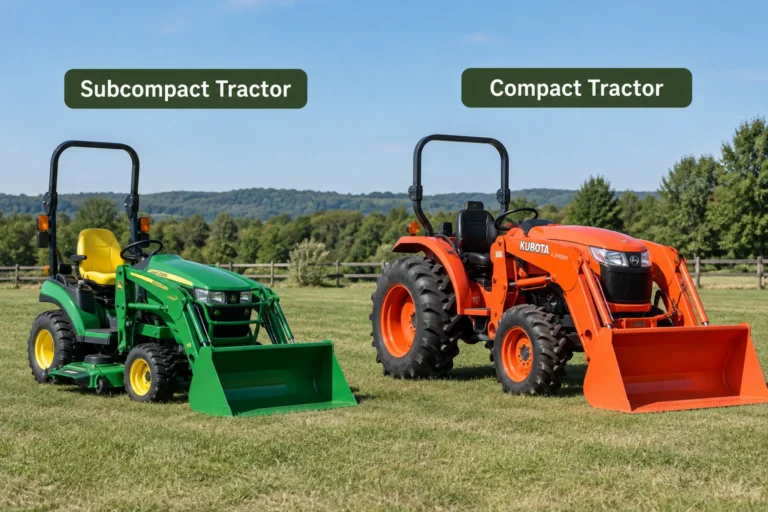
Small-scale farmers are frequently stuck in the “horsepower trap”, where they acquire a 75-HP tractor even though a 35-HP machine would do the job without any fuss. Every additional horsepower adds thousands of dollars to the cost of your loan. In the case of a 10-acre vegetable garden, your “dollar power” will be invested in the quality of the tools that you can attach to the back of a tractor rather than the tractor engine.
Here’s how to find your actual horsepower requirement.
|
Operation Type |
Acreage |
Recommended HP Range |
Why |
|
Market garden (vegetables) |
1–5 acres |
18–25 hp |
Smaller implements, frequent maneuvering in tight rows |
|
Diversified small farm |
5–15 acres |
25–45 hp |
Balance of field work and light tillage |
|
Hay/pasture management |
15–30 acres |
35–55 hp |
Baler and mower requirements drive HP need |
|
Row crop/grain (small scale) |
20–50 acres |
45–75 hp |
Planter and tillage depth push requirements up |
Before you finance a tractor, list every implement you plan to run. Find the PTO (power take-off, the rotating shaft that drives implements) requirement for the heaviest one. Add 20% overhead. That’s your minimum HP. Anything above that is cost without benefit on a small farm.
The Credit Score Reality Check
Agriculture equipment microloans hinge heavily on how personal credit is utilized, which is quite a big deal. For operations smaller than 50 acres, lenders usually consider the farmer and the farm as one. A credit score above 720 typically grants you access to low-interest farm machinery loans that make a
small production scale feasible. If your score is not that high, the only option you will probably have is to Look at the government-backed programs.
Debt-to-Income Ratios for the Small Producer
When lenders evaluate your finances, one of the things they look at is your “Total Debt Service Ratio.” If you have a job separate from the farm that pays your mortgage, they want to be sure that your farm equipment will generate enough “new” money to cover the cost.
How to Qualify for Farm Equipment Financing
Before you pick a lender, you need to know whether you’ll actually get approved, and what you can do right now to improve your odds. Here’s what lenders look at for small farm operations.
Credit Score Expectations
720 or above: You’ll qualify for most options, including conventional bank loans and Farm Credit, at the best available rates.
640–719: You can still get approved through USDA programs and Farm Credit. Expect a slightly higher rate and more documentation requirements.
Below 640: Traditional lenders will be difficult. Focus on FSA microloans, which are specifically designed for farmers who can’t get credit elsewhere at reasonable terms. A local credit union that knows your operation is also worth a call.
Important note: for farms under 50 acres, most lenders treat your personal credit score and your farm’s finances as the same thing. There’s no separating them until you build a formal business credit history.
Income and Cash Flow Requirements
Lenders aren’t just looking at your income; they’re looking at whether your farm can service the debt. Most use a Debt Service Coverage Ratio (DSCR) of at least 1.25. That means for every $1 of annual loan payment, your farm needs to generate at least $1.25 in net income after other expenses.
For a $20,000 loan at 6% over 5 years, your annual payment is about $4,640. Your farm’s net income after seed, labor, and other costs needs to clear $5,800 per year just for that one loan to pencil out.
If you have off-farm income (a second job, a spouse’s salary), most lenders will count it. This is actually a significant advantage for part-time farmers.
Documents You’ll Need
Have these ready before you apply; missing paperwork is the #1 reason approvals get delayed:
- Last 2–3 years of personal tax returns (and farm Schedule F if you’ve been filing one)
- Current balance sheet showing farm assets and liabilities
- Farm income and expense records for the past 2 years
- Description of the equipment you’re financing (model, year, purchase price)
- Proof of farm ownership or a lease agreement if you’re renting land
- A basic farm plan or cash flow projection (FSA and Farm Credit require a one-page summary of your crops, expected yield, and projected income is enough for most small operations)
Common Reasons Applications Get Rejected
- No farm history. If this is your first season, lenders have nothing to evaluate. A USDA FSA microloan is your best entry point; they’re specifically built for beginning farmers with limited track records.
- Debt load is already too high. If you’re already carrying a land mortgage and an operating loan, adding equipment debt pushes your total debt service ratio over lender limits. Prioritize paying down one obligation before adding another.
- Credit score surprises. Many applicants don’t check their credit before applying. Pull your report at AnnualCreditReport.com first. One error can cost you a point tier and hundreds of dollars in interest.
- Equipment age. Most lenders cap financing on used equipment at 10–15 years old. A 1999 tractor may not qualify for a standard loan; you may need to negotiate a personal loan or cash purchase instead.
- Incomplete paperwork. Missing a Schedule F or a current balance sheet stalls the process by weeks and signals disorganization to the lender.
Bad Credit Financing
Can You Get Farm Equipment Financing With Bad Credit?
Yes, but your options narrow, your rate goes up, and you’ll need to be more strategic about which lender you approach first. Here’s how to think through it honestly.
What ‘Bad Credit’ Actually Means to Agricultural Lenders
Farm lenders use slightly different thresholds than auto or mortgage lenders. Here’s where you stand:
|
Credit Score |
Lender View |
Options Available |
Expect |
|
720+ |
Strong — preferred |
All options open |
Best rates, standard terms |
|
680–719 |
Acceptable |
Farm Credit, USDA, local CUs, most dealers |
Slightly higher rate; may need more documentation |
|
640–679 |
Marginal |
USDA FSA microloans, some local CUs, dealer financing |
Higher rate; Farm Credit may require additional collateral |
|
580–639 |
Weak |
USDA FSA microloans, dealer in-house financing |
Limited loan amounts; stronger collateral required |
|
Below 580 |
Poor |
FSA microloan (case-by-case), seller financing, co-signer |
Approval not guaranteed; focus on rebuilding first |
Your Best Options When Credit Is Below 640
1. FSA Microloans – Designed for this situation.
The FSA microloan program explicitly exists for farmers who can’t get credit elsewhere at reasonable rates and terms. That’s the eligibility criteria written into the program. A credit score below 640 doesn’t automatically disqualify you; the FSA looks at your full financial picture: farm experience, a reasonable repayment plan, and collateral. If you have land, equipment, or agricultural products that can secure the loan, you have a real shot.
2. Dealer in-house financing – easier approval, higher cost.
Many equipment dealers, particularly smaller regional dealers, offer their own financing rather than going through a bank. They’re motivated to sell, which means they’re often more flexible on credit. The trade-off: rates are typically higher (8–14%), and terms are shorter. This works for a low-dollar purchase ($5,000–$15,000) where you can pay it off quickly. Don’t use it for a $40,000 tractor if your credit is the only reason you’re going this route.
3. A creditworthy co-signer.
A co-signer with a 700+ credit score, a spouse, family member, or business partner, can unlock conventional financing at much better rates. Be clear-eyed about what you’re asking: if you miss payments, it damages their credit too. This works best when your bad credit is situational (a past medical bill or a one-time financial event) rather than a pattern of missed obligations.
4. Seller financing on used equipment.
Private sellers, farmers selling their own equipment, sometimes offer payment plans directly. No bank, no credit check. The terms are negotiated between you and the seller. This is most common at farm auctions, estate sales, and through word-of-mouth in agricultural communities. The equipment is usually older and sold as-is, so factor repair costs into your budget.
5. Equipment-sharing or co-op arrangements.
If your credit situation means financing isn’t realistic right now, consider splitting ownership of a piece of equipment with a neighboring farm. Two 10-acre farms buying a $14,000 implement together for $7,000 each is better than one farm taking on a $14,000 loan at 12% with a poor credit score. It’s not financing, but it solves the access problem.
Practical Steps to Improve Your Approval Odds
- Pull your credit report before you apply. Errors are common. A single misreported collection account can cost you 30–50 points. Dispute errors at AnnualCreditReport.com, it’s free and legally guaranteed.
- Pay down any revolving balances (credit cards) to below 30% of your credit limit. This is the fastest way to move your score without waiting for negative items to age off.
- Build a paper trail for your farm. Two years of Schedule F filings, a current balance sheet, and a one-page farm plan do more for an agricultural lender than a credit score alone. FSA loan officers are trained to evaluate your score as one input, not the whole picture.
- Consider a smaller, shorter-term loan first. A $6,000 loan on a used piece of equipment that you pay off in 18 months builds your agricultural lending history. That history is worth more than a generic credit score improvement when you go back for a $30,000 tractor.
- Ask about FSA’s Beginning Farmer programs. If you’ve been farming less than 10 years, you qualify for Beginning Farmer loan set-asides, a percentage of FSA loan funds reserved specifically for new operators, with more flexible terms.
Note: If your credit score is below 580 and you have no farm income history, no collateral, and no co-signer pause before applying anywhere. A denial goes on your record and makes the next application harder. Spend 6–12 months building the paper trail: file a Schedule F, open a farm bank account, and pay down any delinquent accounts. Then apply for an FSA microloan with a clean application. One well-prepared application is worth more than three rushed ones.
The 15% Rule That Protects Your Farm
A simple rule that can keep you out of trouble:
Your equipment payments should not exceed 15% of your farm’s expected income
Why?
Because farming income isn’t steady like a salary.
You have:
-
good seasons
-
bad seasons
-
unexpected costs
You can use this table for 15% rules:
|
Farm NOI |
15% Annual Budget |
Max Monthly Payment |
Loan This Supports (7%, 5yr) |
|
$15,000 |
$2,250/year |
$188/month |
~$9,500 |
|
$25,000 |
$3,750/year |
$312/month |
~$15,700 |
|
$40,000 |
$6,000/year |
$500/month |
~$25,200 |
|
$65,000 |
$9,750/year |
$812/month |
~$40,900 |
The 7 Best Farm Equipment Financing Options For Small Farmers
Now that your foundation is clear, let’s walk through your real options, the ones that actually work for small farms.
1. USDA Microloans – The Smart Starting Point
Many small farmers overlook USDA loans because they assume it’s a “last option.” In reality, it’s often the best first move.
USDA microloans in 2026:
-
Go up to $50,000
-
Have lower interest rates (around 4.5%–5.8%)
-
Require less paperwork than traditional loans
But the real advantage is this:
They are designed specifically for farmers like you, not large commercial operations. If your credit isn’t perfect or your farm is still growing, this is one of the most realistic ways to get approved without overextending yourself.
2. Farm Credit Equipment Loans – Built for Farmers
When people search for farm credit equipment loans, this is what they’re looking for.
Farm Credit isn’t just another lender; it’s a system built around agriculture.
What makes it different:
-
Flexible repayment options
-
Competitive rates
-
Patronage dividends (you may get money back)
For small farmers planning to grow over time, this can become a long-term financial partner, not just a loan provider.
3. Used Farm Equipment Financing – The Underrated Advantage
Let’s be honest.
Most small farms don’t need brand-new equipment to be productive. And this is where used farm equipment financing becomes one of the smartest decisions you can make.
Yes, the interest rate might be slightly higher.
But:
-
The loan amount is smaller
-
Your risk is lower
-
Your return comes faster
For many 2–50 acre farms:
Buying used equipment is the difference between staying flexible and being locked into debt.
4. Dealer Financing – Fast, But Read the Fine Print
Dealer financing is popular because it’s easy. You walk in, pick equipment, and walk out with a payment plan.
Sometimes you’ll even see:
“0% financing for 60 months.” Sounds perfect, right?
Not always.
Here’s what happens behind the scenes:
-
You may lose a cash discount
-
The equipment price may be slightly higher
Always compare:
-
Cash price
-
Financing price
Because sometimes that “0%” deal costs you more in the long run.
5. Equipment Leasing – Protecting Your Cash Flow
Leasing is less about ownership and more about access.
For small farmers, this can be useful when:
-
Cash flow is tight
-
You need newer equipment
-
You want flexibility
Lease payments are often:
20–30% lower than loan payments
But remember:
You don’t own the equipment at the end.
6. Local Credit Unions – The Hidden Opportunity
Local lenders are often overlooked, but they can be one of your best options.
Why?
Because they:
-
Understand your community
-
Are more flexible with small operations
-
May offer better terms than big banks
If a national bank turns you down, don’t stop there.
A local lender might see your potential differently.
7. Grants & State Programs – The Money You Don’t Repay
Sometimes the best financing isn’t a loan at all.
Depending on your state, you may find:
-
Equipment grants
-
Soil health programs
-
Energy incentives
For example:
Some programs will cover part of the cost of equipment that improves sustainability.
That’s money you don’t have to pay back.
Real Monthly Payment Examples
Rates and terms only matter when you see what they actually cost each month. Here are three realistic scenarios for small farms, calculated using standard amortization.
Use this calculator to estimate what your monthly tractor payment might look like based on your budget.
Farm Equipment Financing Calculator
|
Scenario |
Loan Amount |
Rate |
Term |
Monthly Payment |
Total Interest Paid |
|
Used walk-behind tractor (20 hp) |
$12,000 |
7.5% |
48 months |
$290/mo |
$1,920 |
|
Mid-size utility tractor (40 hp) |
$28,000 |
6.0% |
60 months |
$541/mo |
$4,460 |
|
USDA Microloan — equipment + tools |
$45,000 |
5.0% |
84 months |
$637/mo |
$8,508 |
Note: Rates are estimates based on 2026 market conditions. Your actual rate depends on credit score, lender, and loan term. Use these numbers as planning benchmarks, not quotes.
What these numbers mean for a 5-acre vegetable farm: If your operation generates $40,000 in gross revenue and $18,000 in net income after all operating costs, the 15% Rule means your total equipment payments should stay under $2,700 per year, about $225 per month. The used tractor scenario at $290/month is right at the edge. The mid-size tractor at $541/month is over your limit. That’s not a reason not to buy, it’s a reason to buy used, extend your term, or grow your revenue first.
The Real Cost of Waiting
Here’s the calculation most farmers skip: if you delay buying a $20,000 piece of equipment for one year because you’re nervous about the payment, and that equipment would have earned you $6,000 in additional revenue during that year, the ‘cost’ of waiting is $6,000 minus whatever interest you saved. At 6%, you saved about $1,200 in interest by waiting. You lost $6,000. The math usually favors moving forward if the equipment genuinely generates revenue.
Lease vs. Loan: What’s Actually Better for Small Farmers?
Most content on this topic gives you a generic comparison. Here’s the version that applies to a 2–50 acre farm specifically.
|
Leasing |
Buying (Loan) |
|
|
Monthly cost |
Lower (20–30% less than a loan) |
Higher — you’re paying down principal |
|
End of term |
Return the equipment or negotiate a buyout |
You own it outright |
|
Tax benefit |
Lease payments are fully deductible as operating expenses |
Section 179 deduction or depreciation schedule |
|
Flexibility |
Trade up when the lease ends |
Sell or keep — your choice |
|
Best for |
High-hour use (500+ hrs/year), shorter planning horizon |
Low-to-moderate use, long-term hold (7+ years) |
|
Worst for |
Farmers who want to modify equipment or hold long-term |
Farmers with tight monthly cash flow |
When to Leasing
- You need a larger, newer machine, but your cash flow can’t handle the full loan payment right now.
- You’re in a crop or operation that’s changing, you don’t want to be stuck with a specialized piece of equipment in 5 years.
- You’re using the equipment heavily (500+ hours per year). At that rate, you’ll put significant wear on it, and leasing lets someone else carry the depreciation risk.
- You want the latest precision ag tech and plan to upgrade every 3–5 years anyway.
When to Buy
- You’re planning to use the equipment for 10+ years. The break-even point on most buys vs. leases falls around year 5–7. Past that, ownership is almost always cheaper.
- You need to modify the equipment for your specific operation, welds, attachments, and custom setups. Leased equipment has to go back in original condition.
- Your usage is seasonal and light (under 200 hours per year). Low utilization means you’re not getting the full value of a lease’s flexibility benefit. Buy used, maintain it well, and it’ll last 20 years.
- You want to build equity. A paid-off tractor on your balance sheet is an asset you can borrow against later.
Best Farm Equipment Financing Strategy by Operation Size
A 3-acre vegetable farm and a 45-acre hay operation are both small farms, but they have completely different equipment needs, revenue profiles, and financing options. Here’s how to think about it based on where you actually are.
2–5 Acres: Keep It Lean
|
BEST FOR: Market gardens, CSA operations, specialty crops, homesteads |
Typical equipment budget: $5,000–$25,000 (compact tractor, tiller, seeder, basic implements)
Best financing approach: USDA FSA operating microloan or dealer financing on used equipment. At this scale, you don’t need a large loan, and keeping debt small protects you in years when the market doesn’t cooperate. A $10,000–$15,000 used compact tractor purchased through dealer financing or a local credit union is the most common and most sensible path.
The 15% Rule in practice: If your 3-acre vegetable operation generates $28,000 in net income, your equipment payment ceiling is $350/month. That comfortably supports a $15,000 loan over 4 years at 7%. It doesn’t support a $40,000 new tractor, don’t let a dealer talk you into it.
Common mistake: Overbuying horsepower. A 25–30 hp compact handles everything a 3–5 acre operation needs. Every extra horsepower costs money in purchase price, fuel, and maintenance. How much horsepower do you actually need for your tractor sizing guide?
Recommended approach: Buy used, buy local (parts availability matters), and keep your first equipment loan under 12 months of your farm’s net income. If you’re in your first season, the FSA microloan is your lowest-friction path to approval.
5–20 Acres: Build the Foundation
|
BEST FOR: Diversified small farms, mixed vegetable/pasture, small hay operations, orchard |
Typical equipment budget: $20,000–$65,000 (35–50 hp tractor, full implement set, possibly a hay tool or sprayer)
Best financing approach: Farm Credit or USDA FSA. At this scale, you’re starting to look like a real farm business to lenders, but you’re still too small for the national ag lenders who focus on 200+ acre operations. Farm Credit associations are built exactly for this bracket. Their rates are competitive, their loan officers understand diversified small farms, and their seasonal payment options (annual or semi-annual) match your actual cash flow. If you’re a beginning farmer (under 10 years), FSA’s Beginning Farmer set-asides give you access to competitive terms even without a long lending history.
The 15% Rule in practice: A 12-acre operation netting $45,000 annually can carry up to $562/month in equipment payments. That’s enough to service a $28,000 loan at 6% over 5 years, a solid mid-range tractor purchase. A $55,000 new tractor at that income level pushes your debt service ratio into risky territory.
Common mistake: Financing multiple pieces of equipment at the same time. Each loan adds to your total debt service. Add one piece, pay it down to manageable levels, then add the next. The farms that get into financial trouble usually didn’t buy the wrong equipment; they bought too much too fast.
Recommended approach: Call your local Farm Credit association before you go to a dealer. They’ll pre-qualify you and give you a realistic budget. Walk into the dealership knowing your ceiling is not finding it out after you’ve fallen in love with a machine.
20–50 Acres: Scale Strategically
|
BEST FOR: Larger hay and grain operations, commercial vegetable farms, livestock with significant pasture |
Typical equipment budget: $40,000–$120,000+ (45–75 hp tractor, full complement of implements, potentially a baler, sprayer, or grain equipment)
Best financing approach: Farm Credit is your primary lender at this scale. You’re large enough to build a real lending relationship, patronage dividends become meaningful, and your loan officer starts to know your operation by name. AgDirect (a Farm Credit subsidiary) is worth comparing on specific equipment purchases. For large used equipment purchases, a competitive quote from your local bank or credit union keeps Farm Credit honest on rates.
The 15% Rule in practice: A 35-acre hay and beef operation netting $80,000 annually can carry up to $1,000/month in equipment payments. That supports a $55,000 loan over 5 years at 6.5%, enough for a quality 60-hp tractor or a used round baler. Multiple loans stacking toward this ceiling is where operations start to feel squeezed.
Common mistake: Taking standard monthly payment schedules on a farm where all revenue arrives in 3–4 months. At this scale, the payment flexibility conversation with your lender is worth having explicitly. FSA and Farm Credit both accommodate annual and semi-annual payment structures tied to your harvest timing.
Recommended approach: At this income level, a simple farm financial plan, a one-page projection showing income timing, loan obligations, and operating expenses by month, takes 2 hours to build and will save you thousands in late fees, interest penalties, and refinancing costs. Lenders also respond better to borrowers who can show they understand their own numbers.
|
Farm Size |
Best Lender |
Budget Range |
Key Priority |
Biggest Risk |
|
2–5 acres |
FSA microloan, local dealer |
$5K–$25K |
Keep debt small |
Overbuying horsepower |
|
5–20 acres |
Farm Credit, FSA Beginning Farmer |
$20K–$65K |
Match payments to cash flow timing |
Too many loans at once |
|
20–50 acres |
Farm Credit, AgDirect |
$40K–$120K+ |
Build a lending relationship |
Standard monthly schedules for seasonal income |
USDA FSA Microloans: The Best Starting Point for Most Beginners
If you’re new to farming, have limited credit history, or can’t get approved through a bank, this is the option you need to understand first.
What are FSA Microloans?
The Farm Service Agency (FSA) microloan program was built specifically for small, beginning, niche, and family farm operations, the farmers that traditional banks often won’t touch. According to the FSA’s October 2024 program overview, microloans cover two categories:
- Operating microloans (up to $50,000): Seeds, fertilizer, tools, small equipment, hoop houses, irrigation, livestock, delivery vehicles, and other annual farm expenses.
- Ownership microloans (up to $50,000): Land purchase or improvement, new or existing farm buildings, closing costs, and soil and water conservation practices.
Combined, you can access up to $100,000 across both types.
Rates and Terms
- Operating microloan rates are based on FSA’s standard operating loan rate at the time of approval. Interest is capped at 5% for beginning and veteran farmers.
- Operating loan terms: up to 7 years (annual operating loans repaid within 12 months or when crops are sold).
- Ownership loan terms: up to 40 years.
What Makes Microloans Different from Bank Loans
- With less paperwork than conventional loans, the application is simplified to match the smaller loan size.
- FSA will consider small business experience and self-guided apprenticeships toward the management experience requirement; you don’t need a farming resume to qualify.
- For beginning farmers: if you’ve successfully repaid an FSA youth loan, that counts toward your experience requirement.
When to Use a Microloan
- You’re in your first 1–3 seasons and don’t have a lending track record yet.
- Your credit score is below 700, and traditional lenders have declined you.
- You need under $50,000 for a specific equipment purchase and want the simplest approval path.
- You’re running a specialty crop, CSA, or non-traditional operation that doesn’t fit a bank’s standard agricultural profile.
When to Look Elsewhere
- You need more than $50,000 for a single piece of equipment. FSA caps each microloan type at $50,000.
- Your farm generates high income, and you have a 700+ credit score. In that case, Farm Credit or AgDirect will likely get you a better rate with less friction.
- You need the money fast. FSA processing takes weeks to months. If you’re buying equipment at an auction next week, dealer financing or a local credit union is your only realistic option.
How to apply: Download the application at fsa.usda.gov/microloans or visit your local FSA office. Find your nearest office at farmers.gov/service-locator. If you get stuck on the paperwork, the FSA office will help you complete it; that’s part of the program design.
Mistakes Small Farmers Make When Financing Equipment
Most of these mistakes aren’t obvious until you’re already locked into them. Here’s what to watch for before you sign.
Mistake 1: Buying More Equipment Than the Farm Can Support
A 10-acre vegetable operation does not need a 75-hp tractor. A 20-hp compact handles most jobs, costs $15,000 less, and uses half the fuel. The financing math follows: a $45,000 loan vs. a $22,000 loan on the same interest rate and term is a difference of $438 per month. That’s $5,256 per year you’re not spending on seeds, labor, or soil improvements.
Before you finance, ask: What is the smallest, least-expensive piece of equipment that will do this job for the next 7 years? Start there.
Mistake 2: Looking Only at the Monthly Payment, Not the Total Cost
Extending a loan term lowers your monthly payment, but it increases your total interest paid. A $25,000 loan at 7% over 5 years costs $4,953 in interest. The same loan over 7 years costs $6,976 in interest. The monthly payment drops from $495 to $377, but you pay $2,023 more in total. That’s not always the wrong move; sometimes, cash flow matters more than total cost, but make the decision deliberately, not because the longer term sounds better.
Mistake 3: Ignoring Cash Flow Timing
Standard monthly loan payments don’t match how farms generate revenue. If you’re a vegetable farmer, most of your income arrives between June and October. A $500/month payment in January and February is coming out of last year’s savings, not current revenue. Ask every lender about seasonal payment schedules, annual, semi-annual, or interest-only during the off-season. FSA, Farm Credit, and many local lenders accommodate this. Most national banks don’t.
Mistake 4: Taking Dealer Financing Without Comparing the Real Price
The ‘0% for 60 months’ offer is attractive. But dealers who offer 0% financing often price the equipment higher than the cash price or withhold a $1,500–$3,000 cash discount you’d otherwise receive. Always ask: ‘What’s the cash price?’ Then calculate what 0% financing on the higher price actually costs compared to 6% on the lower price. You may find the ‘free’ financing costs more than a standard loan.
Mistake 5: Financing Equipment That’s Too Old to Qualify or Too Old to Last
Most lenders won’t finance equipment older than 10–15 years. If you’re eyeing a 2004 tractor, confirm the lender will approve it before you make an offer. Beyond the financing issue: older equipment has higher repair costs. A $12,000 tractor that needs a $4,000 transmission rebuild in year two isn’t cheaper than a $18,000 unit in better shape. Factor expected maintenance into your total cost calculation, not just the purchase price.
Choosing Your Path – A Step-by-Step Decision Framework
This kind of decision, what farm equipment financing is best for your farm and your equipment, shouldn’t be made without a clear mind and a sharp pencil.
Calculating the Total Cost of Ownership (TCO)
The loan payment is only the tip of the iceberg. You have to include:
1. Insurance – Most lenders request insurance coverage for farm equipment called “Inland Marine.
2. Fuel and Fluids – Fuel consumption will be one of the biggest items in your 2026 budget, so you have to care about it.
3. Downtime Cost – Trying to estimate how much money you lose by not working if your tractor breaks down when you are planting, and you have to wait 2 weeks for the parts? Buying the same model but from a local dealer who can fix it quickly might be cheaper in the long run.
Negotiating Seasonal Payment Schedules
Standard monthly payments are for office workers. Farmers’ earnings depend on their harvest. When you are trying to find low-interest farm machinery loans, figure out a payment plan that makes sense for when you will have money coming in.
- Annual Payments – One big check right after selling the crops.
- Semi-Annual – One check in spring and another one in fall.
- Interest-Only Periods – Some lenders will let you pay only interest for the first 6 months while you get your new crop going.
FAQs
What credit score do I need for farm equipment financing?
Most conventional lenders, banks, and Farm Credit associations prefer a score of 680 or higher. USDA FSA microloans are more flexible; the FSA evaluates your full financial picture rather than using a hard credit score cutoff. Dealer financing is typically the most accessible with lower scores, though rates are higher. If you’re below 640, start with the FSA before applying anywhere else.
What are the current interest rates for farm equipment loans in 2026?
Rates vary by lender and creditworthiness: USDA FSA loans run roughly 4.5%–5.8% (capped at 5% for beginning and veteran farmers); Farm Credit associations range from 5%–8%; dealer financing spans 0%–9% depending on promotions; and traditional banks typically land between 6%–10%. The lowest rate doesn’t always mean the best deal; flexibility, approval odds, and total cost over the full term matter more for most small farm operations.
Is it better to lease or buy farm equipment on a small farm?
For most 2–50-acre farms, buying used equipment is the better long-term financial decision. Leasing makes sense when you’re using equipment more than 500 hours per year and plan to upgrade every 3–5 years. If your usage is seasonal and light, under 200 hours per year, a well-maintained used machine you own outright will almost always cost less over a 10-year horizon than a series of leases.
Can I finance used farm equipment?
Yes, and for most small farms, it’s the recommended path. Most lenders finance used equipment, though many cap eligibility at 10–15 years of age. AgDirect, Farm Credit, and local credit unions are good sources for used equipment loans. The interest rate may be slightly higher than on new equipment, but the lower purchase price almost always results in a lower total cost. [Link this phrase to your used tractor buying guide on inspection and valuation.
How long are farm equipment loan terms?
Loan terms vary by equipment type and lender. Most equipment loans run 36–84 months (3–7 years). USDA FSA operating microloans cap at 7 years; ownership microloans can extend to 40 years when land is involved. Longer terms lower your monthly payment but increase the total interest paid. Use the shortest term your cash flow can support.
What documents do I need to apply for farm equipment financing?
Most lenders require: 2–3 years of personal tax returns (including Schedule F if you’ve been filing farm income), a current balance sheet listing farm assets and liabilities, 2 years of farm income and expense records, a description of the equipment being financed, and a basic cash flow projection. FSA applications also require proof of U.S. citizenship and a completed farm plan. Having these ready before you apply cuts approval time significantly.
What is the USDA FSA microloan program, and who qualifies?
The FSA microloan program provides up to $50,000 for operating expenses (seeds, tools, small equipment) and up to $50,000 for farm ownership needs, for a combined total of up to $100,000. It’s designed for small, beginning, specialty, and family farm operations that can’t get credit at reasonable terms elsewhere. The application is simpler than that of a standard bank loan, and the FSA considers farm experience, small-business background, and apprenticeships when evaluating management experience. Find your local FSA office at farmers.gov/service-locator.
Final Thought
If you’re just starting (first 1–3 seasons, small acreage, limited credit):
Apply for a USDA FSA microloan. It’s built for exactly your situation. The paperwork is simpler than a bank loan, the rates are the lowest you’ll find, and approval is based on your full picture, not just your score.
If you have a season or two of track record and a 660+ credit score:
Call your local Farm Credit association before you go to a dealer. Get pre-qualified. Understand your ceiling. Then shop with confidence knowing exactly what you can carry.
If you need equipment fast and have decent credit:
AgDirect and dealer financing are your fastest paths, often approved in days. Read the fine print on any 0% offer. Always ask for the cash price first.
The one rule that protects every decision:
Keep your total equipment payments under 15% of your farm’s net income.
That’s it. Every other calculation flows from that number.
A farm that follows this rule survives bad seasons. One that ignores it doesn’t.
The biggest mistake to avoid:
Financing too much equipment too soon.
One well-chosen, well-maintained piece of equipment bought within your means beats three loans on three machines that stretch your cash flow thin every winter.
Start smaller than you think you need to. Grow into larger equipment, don’t finance your way there before your farm can support it.