

If you run a 2–50-acre farm, seeding is not just another task on a wet field; it’s one of the most important investments you make each season. The way you place seed directly affects germination rates, crop uniformity, weed pressure, and ultimately, your revenue per acre.
So, for small farms, the issue is no longer simply “Which tool is effective?” It’s rather: “Which seeding method will give me the best return on my limited acreage, equipment budget, and labor hours?”
This is a 2–50–acre farm guide dissecting both seed drill vs broadcast spreader use. The article discusses cost ranges, germination performance, soil impacts, maintenance requirements, and real-world decision thresholds to help you protect your pocket and get your fair share of profits.
But before comparing costs and returns, let’s find out how these tools work.
Why is sowing seeds with a seed drill better than broadcasting?
Sowing seeds with a seed drill is better than broadcasting because it places seeds at a uniform depth and spacing, improving germination rates and crop consistency. Broadcasting spreads seeds unevenly, leading to higher seed waste, poor soil contact, and less reliable yields, especially on small farms where efficiency matters most.
Understanding the Core Difference
What Is a Seed Drill?
source: Krishi Verse
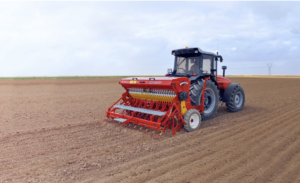
Seed drills for small farms are also commonly known as “direct drills” or “box drills”. Seed drills are used to sow a variety of seeds – generally, oats, lucernes, and grasses – for pasture renovation (producing high-quality feed for animals), mostly on small to medium, mixed or pastoral farms.
The precise placement of the seed results in uniform seedling emergence and fewer seeds being discarded. Besides, pretty much all brand new drills enable you to alter seeding rates according to crop type, regardless of whether you are planting wheat, cover crops, or pasture grasses.
For small farms, seed drills typically range:
- $3,500–$8,000 (used compact models)
- $8,000–$18,000 (new small-acreage drills)
No-till drills that are less disruptive to the soil and maintain soil structure are generally more expensive due to their heavier frames and specialized openers.
Advantages of Seed Drill
- Precise seed placement
- Higher germination rates
- One-pass efficiency
- Better long-term ROI for larger acreage
- Strong resale value
Disadvantages of Seed Drill
- Much higher cost
- Demands more maintenance
- Needs tractor horsepower
What Is a Broadcast Spreader?
source: Agrotechno
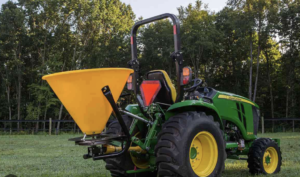
A broadcast spreader is a piece of machinery that spreads seed over the soil surface with a spinning disc or drop mechanism. It can be tractor-mounted (PTO-driven), ATV-mounted, or walk-behind for very small plots.
After the seed has been spread, usually a second run with a harrow, cultipacker, or light tillage tool is necessary to mix the seed with the soil.
Cost ranges are significantly lower:
- $500–$2,000 (basic PTO or ATV spreaders)
- $2,000–$4,000 (heavier-duty agricultural models)
Advantages of a Broadcast Spreader
- Affordable entry point
- Mechanically simple
- Works well for overseeding and certain cover crops
- Low horsepower requirements
Disadvantages of a Broadcast Spreader
- Less uniform emergence
- Higher seed waste potential
- Requires a second pass for incorporation
- Lower precision
How Do Seed Drills Work?
Seed drills have a dual-hopper setup that allows seed and fertilizer to be stored separately before they are combined and banded at sowing. Seed is gravity-fed into fluted rollers, which are either powered by an infinitely variable gearbox linked through a clutch to the land wheels or by an electric drive motor for precision control purposes.
The seed is then delivered through seed tubes located directly behind a tine equipped with a baker boot point or a single- or double-disc opener. They cut a narrow furrow in the soil and place the seed at the right depth.
How Do Broadcaster Spreaders Work?
The seed or fertilizer is not placed in uniform rows but is spread uniformly over the surface of the soil by broadcaster spreaders. A hopper holds seeds or fertilizer released by gravity through an adjustable opening at the base.
A high-speed spinning disc or impeller, attached below the hopper, turns as it moves forward with the spreader. It is either electrically powered via the machine’s ground wheels via a gearbox, or powered by a PTO shaft or an electric motor, depending on the model.
The rotational movement causes the material to move outward in a wide and fan-shaped pattern to cover the field uniformly. The spread width and flow rate can be adjusted to match crop requirements and field conditions.
Seed Drill vs Broadcast Spreader
| Factor | Seed Drill | Broadcast Spreader |
|---|---|---|
| Seed placement | Precise depth & spacing | Random distribution |
| Germination rate | High & uniform | Variable |
| Seed waste | Low | Moderate to high |
| Number of passes | One pass | Often requires 2 passes |
| Cost (initial) | High | Low |
| Best for | Consistent yields, grains, pasture | Quick spreading, low-cost seeding |
Look Beyond the Purchase Price of Cost Per Acre
For small farms, initial equipment costs are only one of the factors. Cost per acre is the most important one.
To make it simple, let’s take a practical example in an area of 20 acres that is a mixed-use farm with small grains or pasture to be utilized.
Broadcast Spreader Farming Equipment Cost
- The mid-range PTO spreader is approximately $780.
- Expected lifespan is 8–12 years.
- Seeded acreage can go 20 acres a year.
- Seed waste is estimated at 5-20% depending on soil conditions.
When you plant a forage crop that costs you $60 per acre to plant, and you broadcast your seed utilization by 10% to combat uneven seed planting, that’s an extra 6 dollars per acre. Over 20 acres, which adds an extra $120 a year to seed costs.
In 10 years, that amounts to an additional $1200 of extra seed alone, almost the price of the spreader itself.
According to the University of Idaho’s extension advice, shallow or uneven placement is a major cause of reduced stand establishment in forage crops.
Seed Drill Cost Scenario
- Equipment cost: $10,000 (new small-acre drill)
- Expected lifespan: 15–20 years with maintenance
- Annual acreage seeded: 20 acres
- Minimize seed waste by improving placement accuracy.
Because drill meter seed is accurate, you typically plant at the suggested seeding rates without overdoing it. Over time, the cost difference between tools is decreased due to lower waste of seeds.
Moreover, better stand establishment often reduces the need for reseeding, another hidden cost small farms cannot afford.
Soil Health Recommendations on 2-50 Acre Farms
The smaller farms are more concerned with the soil structure, organic matter, and fertility on a long-term basis.
Broadcast seeding often requires some level of soil preparation to ensure proper seed-to-soil contact. In many cases, this involves additional tools such as harrows or cultipackers. If you’re unsure which tools to use, see our guide on Soil Preparation Equipment for Small Farms.
According to the USDA Natural Resources Conservation Service (NRCS), reducing tillage helps maintain soil organic matter and makes soil less susceptible to erosion.
For small, diversified farms that practice either rotational grazing or cover cropping, no-till drills will be more suitable for addressing conservation objectives in the long run.
Crop Type Matters More Than Equipment Preference
All crops are different and respond uniquely to seeding methods.
Benefited Crops from Seed Drills
- Small grains (wheat, oats, barley)
- Pasture grasses
- Cover crop blends
Uniform depth is significant to these plants. ISU Extension has always emphasized that proper seeding depth is the initial step to get a stand of plants and maximize yields.
Crops Where a Broadcast Spreader Can Work Well
- Some cover crops (when followed by light incorporation)
- Wildlife plots
- Overseeding pasture
- Frost seeding clover
For example, frost seeding clover onto pasture is commonly done via broadcast spreader farming and relies on freeze-thaw cycles for seed incorporation. In this case, a drill may not provide additional benefit.
Equipment Requirements for Small Tractors
Most 2–50-acre farms have tractors in the range of 25–60 HP.
Broadcast spreaders are lightweight and require less horsepower. They can easily be handled even by small tractors.
The no-till seed drills especially need increased pulling force and weight. It is quite important to match the drill width to the tractors’ capacity. Operating a small tractor with a heavier load will lead to higher fuel consumption and greater wear. Using a small tractor with its full capacity will only consume more fuel.
Small 4-6 foot drills are the most applicable in the farms that have less than 10 acres and 25-35 HP tractors. Drills of 10+ feet are not only unnecessary but also not cost-effective at this level.
Maintenance and Long-Term Durability
Broadcast spreaders are mechanically simple. Maintenance usually involves:
- Greasing fittings
- Checking spinner discs
- Protecting from rust
Seed drills have more moving parts:
- Seed meters
- Openers
- Depth control wheels
- Chains and drive systems
Although long-lasting, they need regular maintenance. Spare parts are costly in the long run.
But since drills have greater resale value when in good condition. This resale market helps minimize the long-term risk of ownership.
A 4-Step Decision Framework of Small Farms
Use this structured approach instead of guessing.
Step 1: Calculate Annual Seed Investment
Multiply:
- Acres seeded annually
- Seed cost per acre
When your investment in the seed is above $2500 to 3000, then precision becomes more important.
Step 2: Estimate Yield Sensitivity
Ask:
- Is emergence a short-term driver in my revenue?
- Am I selling grain, hay, or pasture-based livestock?
When the profitability of your business is strongly tied to the density of forage cover or grain yield, then placement regularity will also be a concern.
Step 3: Assess Labor and Timing Restrictions
- Is there a need to combine an off-farm job?
- Do you have to balance an off-farm job?
- Is tractor time limited?
If time is scarce, single-pass efficiency favors a drill.
Step 4: Consider Soil Goals
If your farming strategy has:
- Reduced tillage
- Cover crop integration
- Soil structure improvement
- Erosion reduction
A no-till drill is more consistent with conservation values of USDA NRCS soil health.
Frequently Asked Questions
Why is sowing seeds with a seed drill better than broadcasting?
A seed drill provides consistent seed depth and spacing, which improves germination and crop uniformity. Broadcasting spreads seeds unevenly, often leading to wasted seeds and inconsistent growth.
What are the advantages of using a seed drill?
Seed drills improve seed placement, reduce waste, increase germination rates, and allow for more efficient use of land and inputs. They are especially beneficial for small farms aiming for higher yields.
What are the disadvantages of using a seed drill?
Seed drills have higher upfront costs, require more maintenance, and need sufficient tractor horsepower to operate efficiently
Is a seed drill vs broadcast spreader worth it for a 10-acre farm?
It can be, especially if you plant forage, small grains, or cover crops annually. If your annual seed investment is significant and yield consistency affects revenue, a used drill may provide long-term savings.
Do seed drills vs broadcast spreaders require more tractor horsepower?
Yes. The minimum required HP for seed drill vs broadcast spreaders is at least 25–40 HP. Always match implement size to your tractor capacity.
Can you get good results with broadcasting seeds?
Yes, but results depend heavily on soil preparation and weather conditions. Germination is usually less uniform than with a seed drill.
What is the most affordable seeding option for small farms?
Broadcast spreaders are the cheapest in first purchase and the least expensive to use on farms of less than 5 acres.
Final Thought
For farms in the range of 2-50 acres, the right decision is no longer about getting the “best” tool. It’s more about buying the tool that fits your farm size, revenue model, and soil management approach when choosing between a seed drill vs a broadcast spreader.
Smaller farms with very limited access to annual seeding might find a broadcast spreader not only more budget-friendly but also sufficient for the job, particularly when cash flow needs to stay flexible. However, as the acreage and the seeding frequency go up, the benefits of improved germination, less seed waste, and single-pass efficiency become increasingly important.
Small farms regularly planting pasture, forage, grains, or cover crops over larger portions of their land, a seed drill for small farms provides better long-term returns through improved stand establishment and labor savings.